
(Ich brauche dringend neue Sportschuhe.)
Now I'll go for a run.
tl;dr:Medicine and humans are difficult.Research is often inconclusive.Please read articles carefully and don't believe everything you read.
An example would be cancer therapy. It is complex and sometimes very frustrating. But everyone is different. And that's not going to change.
And just because there's a pill or therapy that helps one person, another person who has the same disease may not benefit from this therapy.
But just by knowing HOW something happens in the bodyiit doesn't mean we can DO something against it.But there's research.And it takes time.
I could go on and on. There are biochemical and cellular changes as a reason for and as a result of every psychiatric disease. We know this.
People with depression can't take up enough neurotransmitters. People with Alzheimer's have plaques of Amyloid in/around their neurons.
Dear fellow humans: Depression,as every other psychiatric disease,has a somatic factor. There ARE changes to organs and systems in our body.
Say what now? By the way, the first sentence is just SO WRONG. Seriously. How are these people not fired for their bad work.
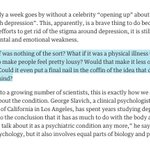
The original The Guardian article offers another gem: "People will accept you're disease more if it's somatic." pic.twitter.com/Dx1NUHzI2m
I personally love the way they try to make a connection to vaccines. Hilarious.
By mentioning the choice of food and the state and size of our bodies they're shaming people.Also:what about thin/"healthy"depressed people?
(I'd say) The main reason for inflammation is infection. By viruses or bacteria or any change to our body that could be harmful.
Third: They claim that the stuff you eat and the way you live causes inflammation.I don't know why they'd emphasize it so much.Ok,I do know.
The text suggested that by finding a test for it, they'd find a cure immediately. Sorry to disappoint, it's not that easy. (Remember HIV?)
And what better way to reduce tissue of all kinds than inflammation.
I do believe that there may be a connection, because research showed that neurons of depressed people are smaller than those who are not.
So if they can't test it, how did they find out? (Did they test spinal fluid? No they didn't they checkt cytokine levels in serum blood.)
Second: They're 5-10 years away from a blood test to measure inflammation. There are tests. Trust me. One of them is CRP.
From this perspective, depression is an endocrinological disease because it's about (a relative lack of) hormones.
Depression (in most cases) is the inability of the neuron to get enough neurotransmitters. Either bc of the lack of them or of receptors.
Depression is and will always be (at least) psychosomatic, because the way the brain works effects our body (and the other way around).
1st of all: "re-branding" depression is not a phrase I consider appropriate. It still has effects on the brain and mind.
Okay listen. This text is probably bs. Let me explain to you why. [https://t.co/g7W0cd1HVp] https://t.co/dGGrgnHZCZ
@henrykploetz erklärt die Rolle in Passion Christ